
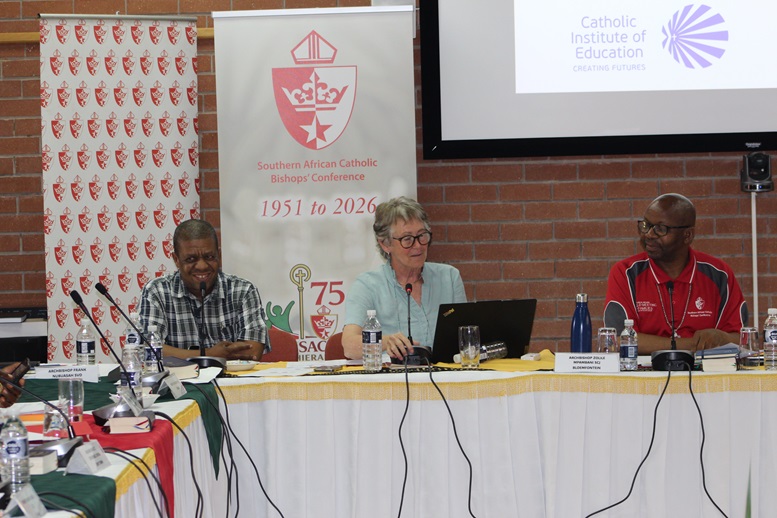
The Catholic Bishops of South Africa, Botswana, and Eswatini, who together form the Southern African Catholic Bishops’ Conference (SACBC), continued their annual plenary session on Friday, 23 January 2026, at the SACBC headquarters, Khanya House, in the Archdiocese of Pretoria.
The day began with morning mass followed by reports from the Office for the Ministry and Development of the Clergy, including reports on ministry to the Deaf community and the role of permanent deacons. Bishops engaged in robust discussion on how the Conference could do more to promote and support permanent diaconate vocations, especially in rural dioceses where parish priests often serve multiple parishes.
The formation of permanent deacons was also discussed, particularly biblical courses traditionally offered at St Augustine College, with questions raised about whether St John Vianney Seminary (SJV) could take on this role. There were also updates given on the Council of Priests (COP).
The bishops then received reports from St Francis Xavier Seminary and St John Vianney Seminary. St Francis Xavier reported receiving over 20 candidates from various dioceses, while also highlighting urgent maintenance needs. St John Vianney Seminary reported that more than 70 seminarians will continue their studies there.
Education featured prominently in the report of the Catholic Institute of Education (CIE). Bishops noted both the challenges and dedication among teachers, the persistence of crime in schools, and the reality that youth unemployment remains high despite a reduction in poverty between 2006 and 2023. Limited access to university education was identified as a major concern.
Concerns were also raised about the impact of government schooling structures on Catholic formation, particularly weekend schooling affecting Mass attendance and sacramental preparation. The bishops reflected on engagement with government through the South African Council of Churches (SACC) and other faith-based organisations, noting that many parents support current arrangements but that the issue requires a stronger, unified response. Early Childhood Development and the role of sodalities were also highlighted.
In the afternoon, the Social Action Department presented its report, with significant focus on mental health through CATHCA. Proposed structural changes were discussed, including the possible reconfiguration of existing units and renaming the department as the Department of Integral Human Development.
The session concluded with discussions on the Department of Home Affairs’ White Paper on Migration, the distribution of diocesan strategic planning booklets, and guidelines on statelessness, underscoring the Conference’s ongoing commitment to pastoral care, social justice, and integral human development.
0 Comments