
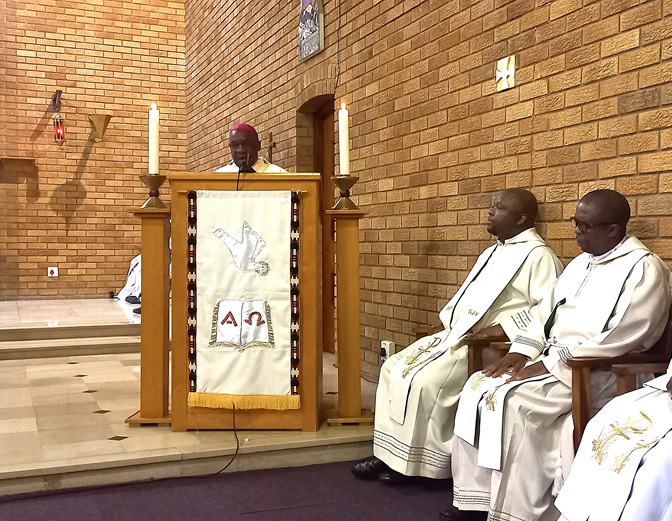
The Chairperson of the Southern African Catholic Bishops’ Conference (SACBC) Commission for Synodality has emphasised that synodality is rooted not in structures or strategies, but in the very life of God.
In his homily on Wednesday, 7 January 2026, Archbishop Dabula Anthony Mpako reflected on the mystery of the Incarnation, reminding representatives from dioceses across Southern Africa that God’s becoming human is central to understanding synodality.
“As I said at the beginning, we are still in the Christmas season in which we commemorate and celebrate the incarnation of God in Jesus Christ,” he said. “Through his incarnation, Christ Jesus has become one of us… and the name given to the child who is born for us is Emmanuel, which means God is with us.”
However, he stressed that the Incarnation goes even further. Christ not only comes to dwell among humanity but draws believers into the very life of God. “Not only did he come to be among us,” Archbishop Mpako explained, “but he came also to draw us into the life of God so that we become children of God.”
The Archbishop of Pretoria Archdiocese went on to highlight that this sharing in God’s life is made possible through the Holy Spirit. “The love of God has been poured into our hearts through the Holy Spirit,” he said, describing the Spirit as “the link that draws us into the internal life of God.” Through this gift, the faithful are invited, he noted, into “the eternal dance of love of our God,” the communion of Father, Son, and Holy Spirit.
In the homily addressed to more than 60 participants who are in Pretoria Archdiocese for the five-day short course on Synodality, Archbishop Mpako said that “Synodality is not just a method, a strategy,” but it’s rather, “something founded on our being incorporated into the life of our synodal God.”
“The Trinity,” he said, “is not just a model for synodality; it is the inner source and the ultimate prototype of all communion and mission.”
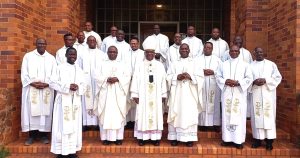
The course on Synodality, hosted at St John Vianney Seminary NPC and running from 5 to 10 January 2026, has drawn clergy, religious, and lay faithful from across the SACBC region for formation and reflection on synodality as a way of being Church.
Explaining the Trinitarian basis of synodality, Archbishop Mpako described the Trinity as a communion that preserves both unity and difference. “This is a unity that does not erase difference but is constituted by the gift of self between persons,” he said.
Such communion, he added, has clear implications for how the Church relates internally, calling believers to mutual love, listening, and shared responsibility.
For the Church, this means rejecting both clericalism and a purely secular, democratic understanding of decision-making. “This understanding of synodality rejects clericalism, where we put clerics on a pedestal,” Archbishop Mpako said, “and at the same time, it rejects a purely democratic, secular understanding of the Church. Synodality is based on the life of the Trinity.”
He described synodality as “the participation of the Church in the life of the Trinity,” portraying the Church as a people “called by the Father, gathered in the name of the Son and guided by the Holy Spirit, journeying through history as a sacrament of salvation.”
Summing up the heart of his message, Archbishop Mpako returned to the central theme of his homily: “Synodality, therefore, is not just a method or a strategy designed to make the Church more efficient or more democratic. Rather, synodality is about making the Church more authentic and trinitarian.”
This call, he said, requires a deep conversion of mindset. Quoting Pope Francis, he reminded participants that “it is this synodality that God desires for the Church of the third millennium.” Moving away from a pyramidal model of Church towards a listening, discerning community will not be easy, he acknowledged, but it is essential.
“Until we have undergone that mindset change,” he cautioned, “synodality is not going to happen.” Formation initiatives such as the short course, he said, are therefore crucial in helping clergy and laity alike to overcome fears and anxieties and to trust the work of the Holy Spirit.
Concluding his homily, Archbishop Mpako invited those present to prayerful openness: “Let us pray for the grace to embrace the conversion that is called for, so that, having been drawn into the inner life of our Trinitarian God, we may reflect that synodality in the way we live and journey together as Church.”
0 Comments