
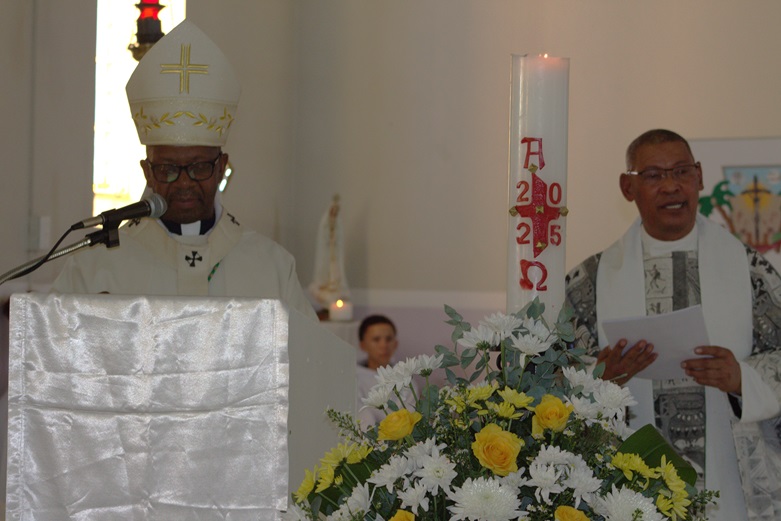
In his first interview since assuming responsibility for the Diocese of Keimoes–Upington, Archbishop Zolile Peter Mpambani SCJ has spoken openly about the mission entrusted to him as Apostolic Administrator, describing it as a call to service received in humility and trust in God.
Speaking during his visit to Upington for the Memorial Mass of the late Bishop Edward Gabriel Risi OMI, the Archbishop acknowledged that the role comes with both pastoral responsibility and personal sacrifice, particularly given the vast geographical distances between his Metropolitan Archdiocese of Bloemfontein and the Diocese of Keimoes–Upington.
“I received this mission with mixed feelings,” Archbishop Mpambani said. “Not many people would wish to carry responsibility for two dioceses at the same time. But when the finger is pointed, it is pointed. One does the best one can and leaves the rest to the owner of the vineyard.”
A Mission Rooted in Service
Archbishop Mpambani emphasised that the role of Apostolic Administrator is not about authority or prestige, but about ensuring continuity in the pastoral and administrative life of the diocese during a time of transition.
“It means taking responsibility for the life of the diocese and caring for the People of God together with those already serving here,” he explained. “In practice, it is the same responsibility as that of a diocesan bishop.”
At the same time, Archbishop Mpambani stressed the importance of listening and discernment, noting that he begins this mission conscious of the need to learn.
“I do not yet know the full reality of the diocese,” he said. “That will come through listening, through dialogue, and through walking with the clergy and the faithful.”
Gratitude for a Faithful Shepherd
Reflecting on the legacy of the late Bishop Edward Risi OMI, Archbishop Mpambani spoke with appreciation of a fellow bishop whose dedication left a lasting imprint on the diocese and on the Church in Southern Africa.
“He was a very committed and disciplined pastor,” the Archbishop said. “If he was entrusted with a task, you could be sure it would be carried out thoroughly and without delay.”
He highlighted Bishop Risi’s particular love for the liturgy and his conviction that the faithful should encounter the Church’s teaching in their own language, especially through Afrikaans liturgical texts, hymns, and reflections.
“This was not simply a personal interest,” Archbishop Mpambani noted. “It was a pastoral conviction that helped people to participate more fully in the life of the Church. That legacy will continue.”
Walking Together in a Synodal Church
Addressing the Church’s ongoing synodal journey, Archbishop Mpambani said that his mission in Keimoes–Upington will be marked by collaboration and shared responsibility rather than by predetermined plans.
“My appointment is still very recent,” he said. “There has not yet been time to formulate concrete programmes.”
Nevertheless, he expressed confidence that the Diocese of Keimoes–Upington is already living the spirit of synodality.
“In recent discussions at the metropolitan level, it was clear that the priests of this diocese are already well formed in synodality,” he said. “The task, therefore, is to walk with them, to listen, and to support what is already being lived.”
Trusting God in a Time of Transition
As he begins this interim mission, Archbishop Mpambani appealed for patience and cooperation, reminding the faithful that the life of the Church is sustained not by individuals alone, but by God’s grace.
“Our task is to be faithful in what we are asked to do,” he said. “The rest we entrust to the Lord.”
0 Comments